✨ Direct for a video from words
No picture needed: it builds the whole scene for your length and frame shape, with timed beats and speech. Free.
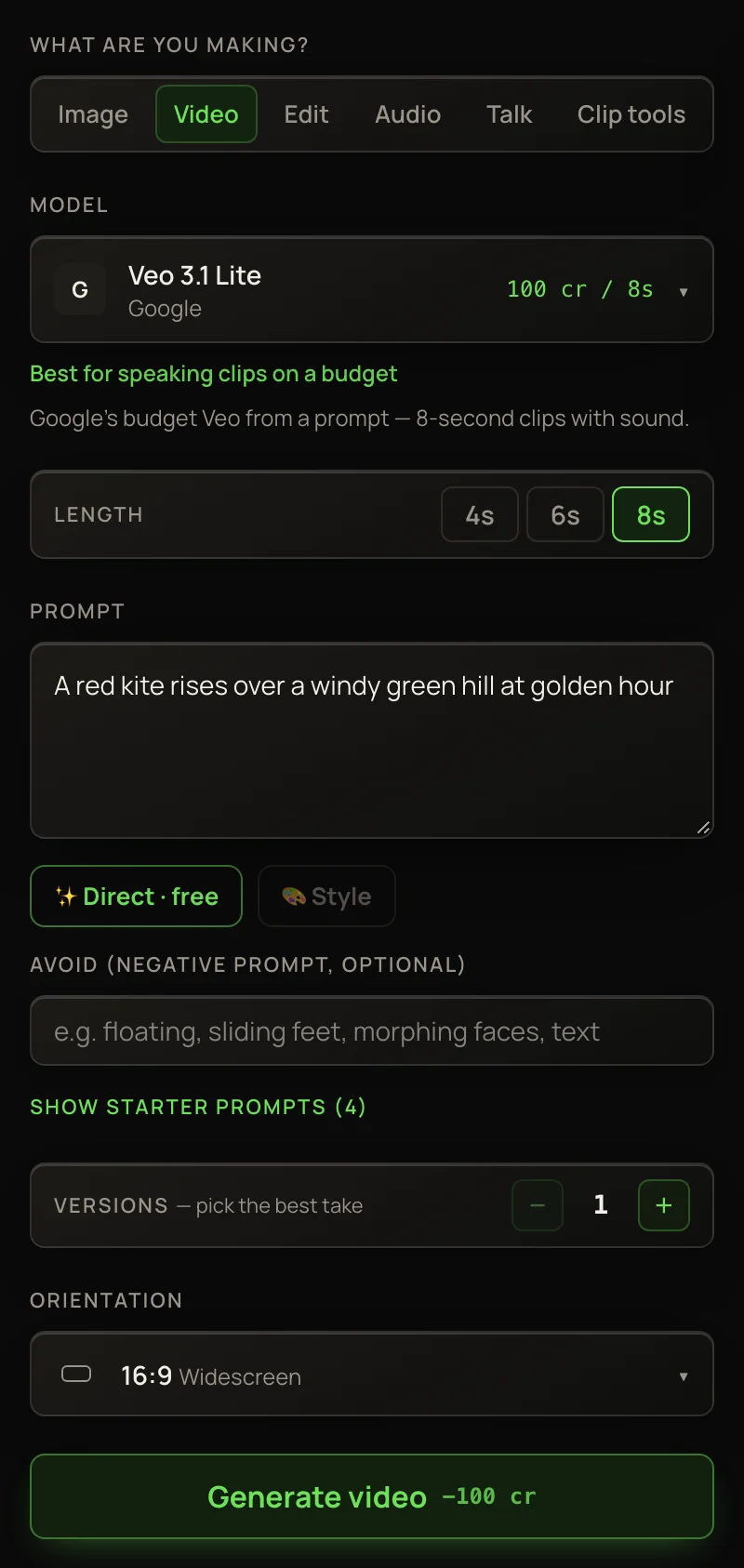
Open Veo 3.1 LiteOn models tagged Text→video, which make a clip from words alone, ✨ Direct writes the whole scene. In the Studio it builds it for the length and frame shape you picked above the button. On a Flow box it writes for the model’s standard length (8 seconds on Veo, 5 on most others) and a wide 16:9 frame.
New to it? Start with the overview:✨ Direct: Turn a rough idea into a full prompt.
What comes back
With no picture to start from, the Director builds the whole scene: the camera and where it stands, the people and place in concrete detail, a layout made for your frame shape (stacked up and down for tall 9:16, side by side for wide 16:9), the opening pose, the action, the end, and the look. For clips of 8 seconds or more it splits the action into timed beats — “0–5 seconds: …”, “5–10 seconds: …” — so the model knows what happens when. Mouths stay closed unless you asked someone to speak.
The acting, in every video
Whenever a person or animal with a face is in the shot, the Director also directs the performance. Instead of writing a feeling (“he is nervous”), it writes what a camera could actually see: where the eyes look in each beat, a hand pausing, a slow breath, a natural blink. This makes characters look alive and thinking — without adding any extra action you didn’t ask for.
It also fills the Avoid box with common video mistakes. SeeThe Avoid box.
Example: 10 seconds, wide 16:9
A grumpy garden gnome finds a tiny letter in his mailbox.
Camera: a slow push-in from a wide, low-angle view of the garden corner to a medium-wide frame of the gnome and his mailbox, steady and smooth, finishing close enough that the gnome and the letter in his hand fill the middle of the frame.

Scene: a small, overgrown cottage garden in the morning. A grumpy garden gnome, a living ceramic figure about knee-high, stands on a flat stepping stone at the left third of the frame. He has a round, chipped-glaze nose, heavy white painted eyebrows, a long white beard that hides his mouth, a pointed red hat with a faded tip, a blue jacket with brass buttons, brown boots and stubby painted hands. To his right, at the right third of the frame, a tiny weathered wooden mailbox sits on a mossy post, with a little red flag and a hinged round-topped door. Foxgloves, ferns and soft green grass spread across the background. The camera stands a few steps away at the gnome's eye level, and he stands turned three-quarters toward it, with the mailbox beside him.

Composition: wide 16:9. The gnome on the left and the mailbox on the right are balanced side by side, with the garden stretching out behind them in layers of leaves and flowers.

Opening frame: the gnome is already planted on the stepping stone, boots flat, weight settled, shoulders low and hat tilted slightly forward.

0–5 seconds: The gnome's eyes stay fixed on the mailbox as his brows sit low and heavy. He breathes slowly, and his round belly rises and falls. His right hand reaches out, and he taps the red flag once with a stubby finger and lifts the little door open. He leans his head forward, his eyes narrowing at the dark opening. His fingers pinch inside and draw out a tiny cream envelope, no bigger than his thumb, sealed with a dot of red wax. His boots never leave the stone.

5–10 seconds: He brings the envelope up in front of his face, and his eyes stay locked on the red wax seal. He holds the pose for a long beat and blinks slowly. His heavy brows lift a fraction, and his round cheeks rise above the beard. His other hand comes up and presses the letter gently against the front of his blue jacket. His gaze then rises from the envelope to the lens, brows still low but softer, and he settles into stillness.

Secondary motion: the long white beard sways slightly with each breath, the foxglove bells nod in a light breeze, and warm dust and pollen drift in the slanted sunlight.

End frame: the gnome stands on the stone, holding the tiny letter against his chest, looking at the camera, with the open mailbox beside him. The camera rests in a medium-wide frame.

Look: warm morning sunlight with soft shadows, rich greens and a saturated red hat, finished as a cinematic photograph with a shallow depth of field.

The same characters, faces, clothing and props from the first frame to the last. The gnome's mouth stays closed and silent for the whole clip.
One sentence became a full little story with two timed beats: he opens the mailbox and finds the letter, then he looks at it, softens, and looks up at the camera.
Example with speech: 8 seconds, tall 9:16
A retired circus strongman with a handlebar moustache at a bakery counter asks for the last croissant, in a gruff, warm baritone voice: "Is that one taken?"
Locked-off static shot at chest height, framed vertically from the counter's edge, the strongman filling the height of the frame with the glass pastry case in the lower third and a hanging chalkboard menu and pendant lamp stacked above him, the camera holding still from the first frame to the last.

A retired circus strongman, late sixties, enormously broad through the shoulders and chest, stands behind nothing but the front of a small neighbourhood bakery counter, facing the camera across it. He has a thick, waxed silver-grey handlebar moustache curled at both tips, a bald tanned head, and deep smile lines. He wears a snug mustard-yellow knitted vest over a rolled-sleeve cream shirt, his forearms thick and freckled, with a faded blue anchor tattoo on one. The counter is pale wood with a glass case below holding a single golden croissant on a white paper doily, the last one on an otherwise empty tray. Behind him through the shop window, a soft blurred street glows in morning light. A young baker in a flour-dusted apron stands at the right edge of the counter, shown only as a shoulder and hand, holding a pair of tongs.

Opening frame: the strongman stands planted square to the counter, both feet flat on the tiled floor, weight even, his big hands resting on the wood edge, eyes on the croissant in the case.

0–4 seconds: He studies the croissant, his gaze fixed on it, chest rising in slow breaths, a natural blink. His moustache twitches slightly as he draws a breath. His eyes lift from the pastry to the baker's hand with the tongs at the edge of the frame, and his head tilts a few degrees toward them, feet staying planted.

4–8 seconds: He looks straight into the baker's face, brow lifting gently, and says in a gruff, warm baritone voice: "Is that one taken?" His mouth moves only for these words. After he speaks, his eyes drop back to the croissant and the corners of his moustache lift in a small hopeful smile as the baker's tongs move toward the case. He holds still, hands on the counter.

Secondary motion: dust motes drift in the window light behind him, the pendant lamp casts a faint warm glow that shifts slightly on the glass, and a thin curl of steam rises from an unseen oven at the edge of the frame.

End frame: the strongman stays centred at the counter with a hopeful smile, eyes on the croissant, tongs entering the frame beside the glass case, the camera still.

Warm morning light with soft golden tones, creamy yellows and honey wood, shallow depth of field, cinematic photograph finish.

The same characters, faces, clothing and props from the first frame to the last. Only the strongman speaks; the baker's mouth stays closed and silent for the whole clip.
The spoken line is kept word for word, with the voice described right next to it, and placed in the second beat. The shot is built tall — menu and lamp above him, pastry case below — because the frame shape picked was 9:16.