✨ Direct for a video from a picture
It studies your starting picture and writes how everything moves, beat by beat. Free.
Open the Video laneIn the Video lane, on models that bring a picture to life, and on Flow’s Animate box, ✨ Direct studies your starting picture (and your end frame, if you set one) and writes how everything moves.
New to it? Start with the overview:✨ Direct: Turn a rough idea into a full prompt.
What comes back
First the Director decides what kind of clip it is:
Either way, everyone’s mouth keeps the expression it has in your picture and stays silent, and faces, clothes and colours stay the same from start to finish.
The acting, in every video
Whenever a person or animal with a face is in the shot, the Director also directs the performance. Instead of writing a feeling (“he is nervous”), it writes what a camera could actually see: where the eyes look in each beat, a hand pausing, a slow breath, a natural blink. This makes characters look alive and thinking — without adding any extra action you didn’t ask for.
It also fills the Avoid box with common video mistakes. SeeThe Avoid box.
Example: notes in, prompt out
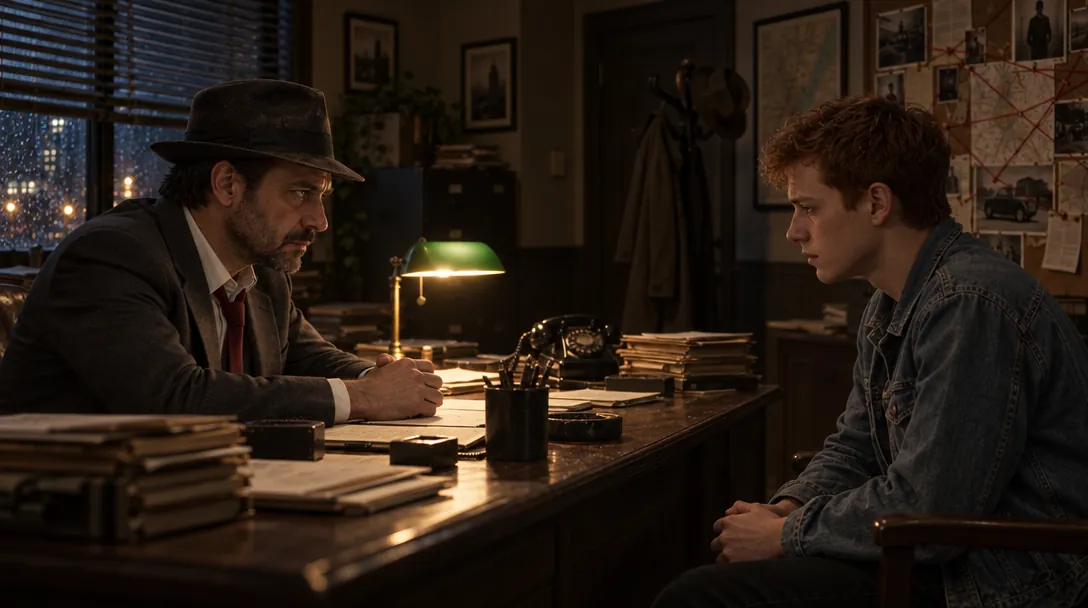
The detective pushes a photograph across the desk toward the young man.
Slow push-in from a steady, low two-shot, easing a few inches toward the desk so the photograph's path stays centered between both men. Film-noir drama, moody and low-key, with warm lamplight against cold blue rain-light. A dim private-eye office at night: the detective in a dark fedora, charcoal tweed jacket, white shirt and dark red tie sits behind a cluttered mahogany desk on the left. The young man with tousled red hair and a worn denim jacket sits in a wooden chair on the right. The green banker's lamp glows, the black rotary phone and pen cup sit on the desk, and rain streaks the window behind them.

Opening frame: the detective sits planted in his chair, forearms resting on the desk, hands clasped on the blotter, a single small photograph lying on the wood just beneath his fingertips. His eyes are fixed on the young man's face. The young man sits upright in his chair, boots on the floor, hands loosely clasped between his knees, eyes on the detective.

Motion arc: the detective's right hand unclasps and two fingers settle flat on the photograph's edge. His eyes stay on the young man for a beat. Then he pushes the photograph forward in one steady, deliberate motion, his forearm extending and the paper travelling across the polished wood past the lamp and the pen cup. His gaze follows it down for one moment, then lifts back to the young man's face. The photograph comes to rest near the desk's right edge, in front of the young man, and the detective's fingertips release it and settle on the blotter. The young man's eyes stay on the detective until the paper nears, then drop to the photograph and stay there, his brow tightening slightly as he takes it in. His hands stay clasped between his knees.

Ground contact: both men stay in their seats with feet planted and weight settled into the chairs. Only the detective's shoulder, forearm and fingers move, and the paper's edge keeps light contact with the desk's surface the whole way.

Secondary motion: rain trickles down the window glass behind the detective, the lamp's warm glow shimmers faintly on the varnished desktop, and a slow breath lifts each man's shoulders with a natural blink.

End frame: the camera finishes slightly closer on the desk. The detective sits back with his hand resting near the blotter, the photograph lies in front of the young man, and the young man looks down at it.

The detective's mouth stays closed in a firm, flat line beneath his beard, and the young man's mouth stays gently closed. Each mouth keeps the expression it has in the first image and stays silent for the whole clip; the only motion is the camera move, the action described, and the secondary motion.
Notice what it added: the camera move, the exact starting pose read from the picture, the push broken into small steps, where each man is looking at every moment, and both mouths kept as they are in the picture.